

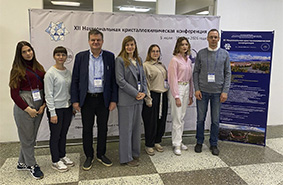
 A large group of SCTMS staff participated in the 12th National Crystal Chemistry Conference, which was held from July 5 to 10, 2026, in Apatity, Murmansk Region. Presentations were given by Prof. V.A. Blatov, Dr. A.A. Kabanov, Dr. O.A. Blatova, E. Barabanova, E. Bukhteeva, M. Smirnova, and V. Nikitina.
Leading Researcher Dr. Artem Kabanov of the SCTMS delivered the keynote address, "Theoretical Methods for Searching for New Crystalline Ionic Conductors," in which he provided an overview of the ionic conductivity modeling methods being developed at our research center. Prof. Vladislav Blatov presented a paper, "Methods of Dual Crystal Chemistry in Reticular Design," focusing on methods for the topological analysis of free space in crystals.
The remaining participants presented posters. Senior Researcher Dr. O. A. Blatova's report, "Topological Assembly Schemes in the Reticular Design of Coordination Polymers," focused on recent developments in topological methods for modeling solid-phase reactions. Junior Researchers Ekaterina Barabanova's reports, "Hierarchical Models for the Assembly of Metal-Organic Frameworks from Low-Dimensional Structural Groups," and Ekaterina Bukhteeva's "Analysis of Free Space in Metal-Organic Framework Structures by the Natural Tiling Method," described new topological approaches to analyzing coordination polymers and metal-organic framework compounds. Research assistants Maria Smirnova's reports, "Topological Classification of the Crystal Structures of Silicides, Nitrides, and Polynitrides," and Varvara Nikitina's "Hierarchical Relationships of Molecular Packing Topologies in Coordination Compounds," examined the initial results of new research areas at the SCTMS — high-energy polynitrides and molecular coordination compounds.
"We traditionally participate in National Crystal Chemistry Conferences with large delegations because this is the main Russian scientific forum on crystal chemistry issues, which is the focus of our research center," comments Professor V. A. Blatov. "Our colleagues from all over the country come to these conferences—this year, there were over 300 participants. Of course, we meet many acquaintances with whom we discuss joint work and find new areas for collaboration. These conferences are especially useful for young people—they see firsthand how diverse and strong Russian science is. I hope we can organize one of the next conferences in Samara."